 IDEAS THAT CHANGE THE WORLD
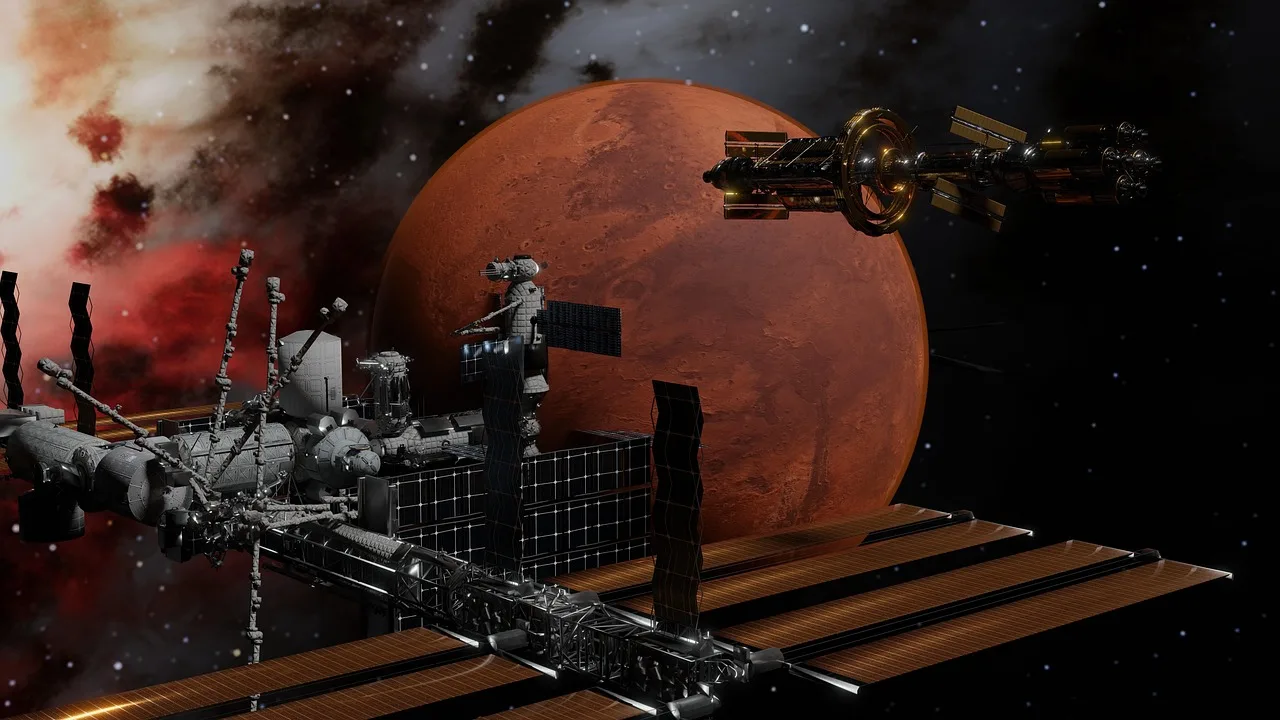
Science-fiction films portray life on Mars as an exciting adventure: spacecraft landing on sandy plains, bases with transparent domes and settlers ready to grow potatoes in high-tech greenhouses. Science, however, highlights many difficulties that prevent us from living on Mars.
Although rocket technology is making enormous strides towards taking us to the Red Planet, human biology is the real problem. Our bodies evolved over millions of years to live under the protection of the atmosphere and gravity. Transporting them to Mars means exposing them to a hostile environment that current technology cannot yet neutralise.
Living on Mars: cosmic radiation
On Earth, we are protected by a double, invisible shield: our thick atmosphere and a powerful global magnetic field generated by the molten iron core at the planet’s centre. Mars, by contrast, lost its magnetic field billions of years ago and has an extremely thin atmosphere, less than 1% of Earth’s. Cosmic rays could therefore directly affect the human body.
During the months of travel to Mars and their stay on the surface, astronauts would be bombarded by two kinds of radiation:
- Cosmic rays: extremely energetic particles originating outside the solar system, capable of passing through spacecraft’s metal walls.
- Solar particle events: radiation storms emitted by the Sun.
Prolonged exposure to this radiation not only creates a very high risk of developing cancer, but causes direct damage to the central nervous system, cognitive deterioration and heart damage. Current shielding, using lead or water, would make spacecraft too heavy to take off. The solution? Build the first Martian bases underground, inside volcanic-sedimentary lava tubes.

Microgravity and reduced gravity
Gravity on Mars is around one third of Earth’s. We know what happens to the human body in the absence of gravity, but we have no idea what happens to human biology after years of exposure to reduced gravity.
The documented physical problems are severe:
- Muscle atrophy and bone demineralisation: Without the load of Earth’s gravity, bones lose up to 1.5% of their density per month, releasing calcium into the urine and increasing the risk of fractures and kidney stones.
- Neuro-ocular syndrome: Without strong gravity, bodily fluids move towards the head. This increases pressure inside the skull and compresses the eyeball, causing permanent visual damage and blurring that no glasses can correct.
If a crew landed on Mars after eight months travelling in weightlessness, the astronauts might not even be able to stand up to walk on the surface.

Living on Mars: poisonous soil
In the film The Martian, the protagonist survives by growing potatoes in Martian soil enriched with manure. In reality, this would have poisoned him within weeks. Regolith, the Martian sand, is saturated with perchlorates, toxic salts with strong oxidising properties that destroy the thyroid and burn lung tissue if inhaled.
Furthermore, Martian dust is not rounded like the sand in our deserts: without water erosion, its grains are microscopic, electrostatic shards of glass. They would therefore cling to astronauts’ suits and inevitably enter habitats when the crew returns, causing serious respiratory diseases.
Before planning cities on the Red Planet, science and technology still have a long way to go. Until then, Mars will remain a place that is wonderful to explore with robots but deadly for humans.