 IDEAS THAT CHANGE THE WORLD
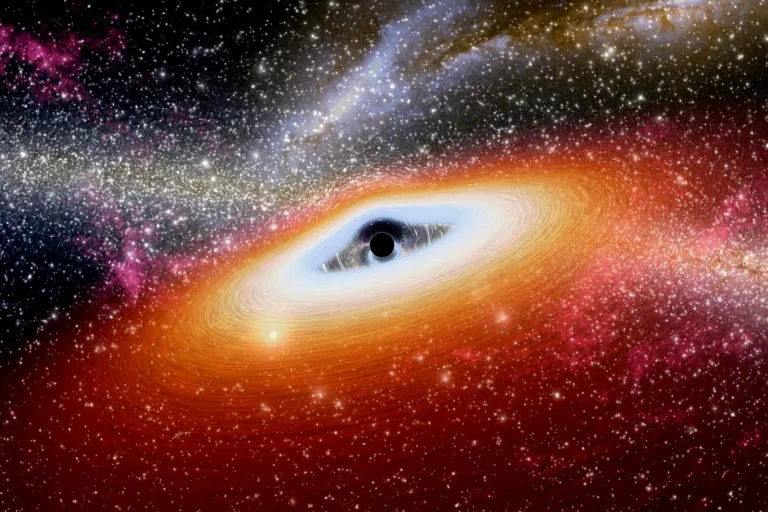
When we say “new moon”, we usually mean the lunar phase and our own satellite. This time, however, it really is a “new” moon, located in another solar system. Specifically, in CD‑35 2722, at a distance of 73 light-years from us. The discovery comes from the Very Large Telescope operated by ESO, which detected the celestial body using radial velocity.
According to a study titled “Satellite Detected Around a Star’s Substellar Companion”, the new moon would be a rather unusual extrasolar satellite, because it orbits not a planet but a celestial body known as a “brown dwarf”. If so, it would be the first satellite of this kind ever discovered.
A new moon orbiting a brown dwarf
As noted, the new moon identified in CD‑35 2722 orbits a brown dwarf thirty times larger than Jupiter. This in turn orbits the star that gives the entire system its name, with half the Sun’s mass. It is therefore a relatively young star that has aroused experts’ curiosity.
The celestial body observed by the Very Large Telescope is thought to be gaseous. Its mass is not far from that of Jupiter, so initial findings suggest it could qualify as a “planet” in its own right. Conversely, the brown dwarf is far too large to be a planet, yet lacks the nuclear reactions typical of stars.

According to Professor Zurlo of Universidad Diego Portales, our Solar System has well-defined and well-studied boundaries between different celestial bodies. Not so in CD‑35 2722, where distinctions often blur, challenging scientists’ understanding and opening the door to new theories.
In the past, Kepler had also observed celestial bodies comparable to moons; further investigation, however, disproved their existence. The exomoon in CD‑35 2722 is therefore the first moon discovered in a solar system other than our own.
How the Very Large Telescope discovered the extrasolar satellite
This is not the only significant discovery made with the Very Large Telescope. Also in July, a team from the University of Edinburgh identified a third exoplanet in the Beta Pictoris, system, called Beta Pictoris d. This time, the object orbiting CD‑35 2722 was discovered by Quentin Kral and a research team including Professor Zurlo and researcher Kevin Hoy from Chile’s Universidad Diego Portales and the Millennium Nucleus of Young Exoplanets and their Moons (YEMS).

How did the Very Large Telescope identify the exomoon? Scientists used CRIRES, a high-resolution cryogenic infrared spectrograph. Kevin Hoy describes the fascinating procedure in the study: using VLTI/GRAVITY, the team examined the brown dwarf’s astrometric positions over both short periods, measured in months, and long periods, measured in years. The radial-velocity method—the same technique that revealed an exoplanet orbiting a Sun-like star in the 1990s—then indicated the orbiting body’s presence.
According to the research, the satellite in CD‑35 2722 may take 170 days to complete an orbit around the brown dwarf. The possibility of two satellites with circular orbits of 170 and 87 days has also been raised. This hypothesis is considered less likely, though further investigation will be needed for certainty.